
Floodlights on the Reef
How dredging turns a shoal into a permanent outpost and forces everyone else to adapt.


Floodlights First
Floodlights are the first tell. Runways come later.
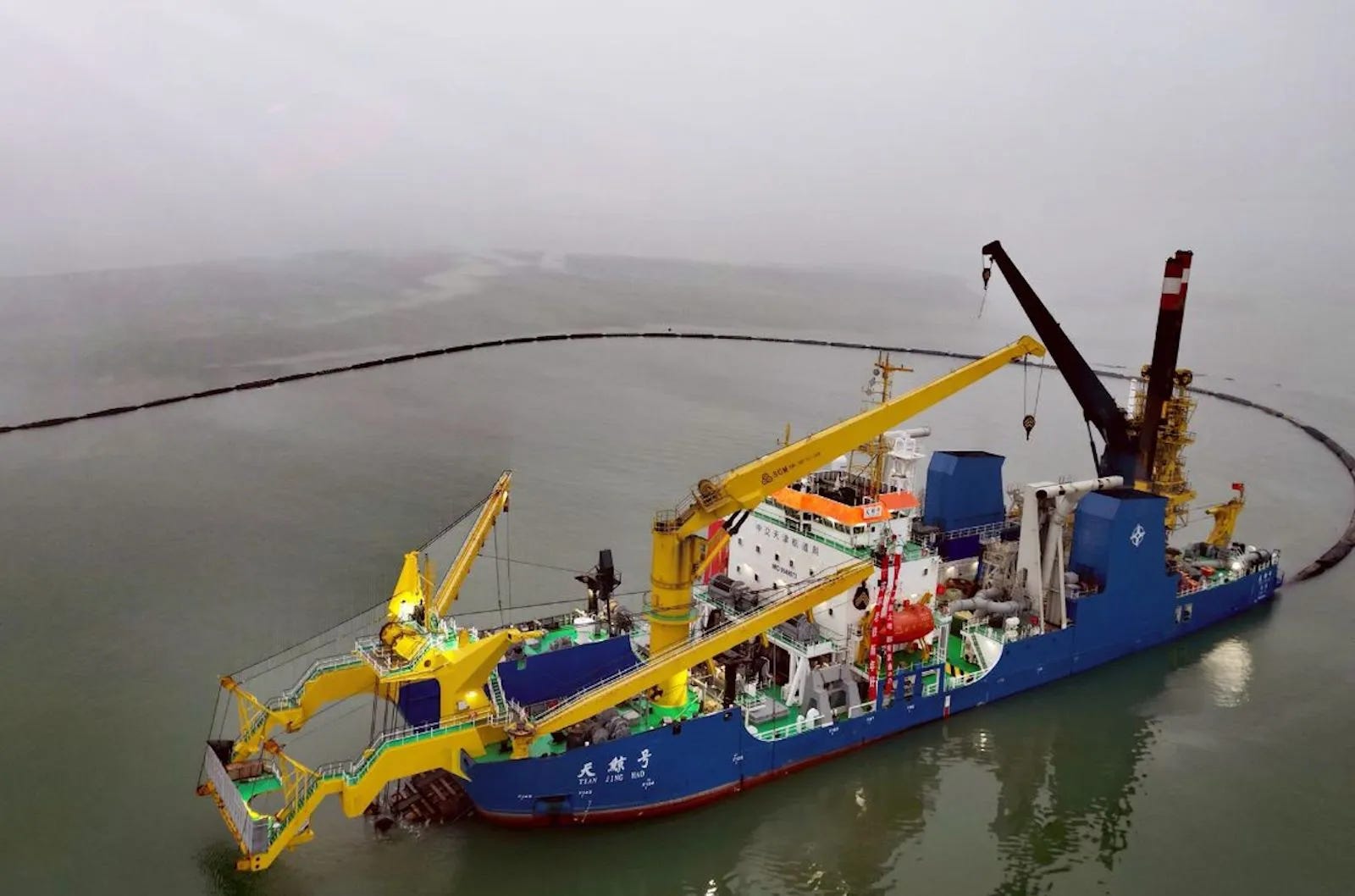
Out on a shoal, a working deck burns white through the night where the chart still says reef. The dredger runs 24/7. Pumps keep pushing a milky plume outward until the lagoon’s blue looks diluted, then erased.1
In daylight it looks almost boring: barges, hoses, straight lines. In photos it reads as construction.
The method is subtraction. Bury the living reef under fill, then armor it with rock and seawalls. Once a pier exists, “presence” becomes a schedule: regular resupply, rotating crews, predictable patrol tempo.
By the time the platform is obvious, the reference point is already gone.
Dredged Into Existence
These islands are dredged into existence.
A dredger chews up a reef and turns it into slurry. It sucks sand, coral rubble, and sediment from the lagoon and reef edge, pumps the mix through a discharge line, and dumps it onto the reef until a pale pad rises above the tide line. Crews then lock it in with rock and seawalls and add what makes it usable: a pier and roads—and on the largest sites, major port facilities and airfields.2
The tells come in order: milky water and a down-current plume; a crisp armored perimeter; a pier and steady shuttling to larger ships offshore; then repetition—the same approach lanes, the same night lights, the same routines.
A pier makes the whole thing operational. Once resupply and rotations run on a timetable, “presence” becomes continuous.
The harm also spreads beyond the outline. Burial kills the reef under the fill, and sediment drifts down-current, smothering coral outside the neat construction footprint.
The Ledger
Debate stays easy until the evidence is countable. Pentagon estimates put the Spratly build-out from 2013 to 2016 at more than 3,200 acres of new land across seven occupied features.3
Before: a thin line of surf over a reef, blue water inside it.
After: a pale polygon above the tide line, edged with rock. The reef underneath has become foundation under fill. Beyond the perimeter, the water shows spillover—plumes, smeared edges, and damage that extends past the construction outline.
A before-and-after captures three physical changes at once: land added, reef buried, harm spread. Once the seafloor is reshaped, the question shifts from “should this exist” to “how does everyone operate around what exists now.”
Friction
Ecological damage changes behavior. That is where it becomes strategic.
Reefs are nurseries and habitat.4 When habitat gets buried or smothered, fishing effort shifts. Boats range farther, stay out longer, and crowd into fewer productive patches. That crowding pushes more traffic into the same waters where patrols already run “routine enforcement,” which raises the number of encounters.
In practice it looks mundane: a radio hail, a slow shadowing run, an “inspection” that burns hours, an escort line that pushes boats off a productive edge. The cost rarely shows up as a headline. It shows up as lost time, fuel, gear damage, and fewer safe options the next day.
Reefs are also physical infrastructure. Healthy reef structure breaks waves and helps keep water clear.5 Dredging muddies the water and blocks light; fine sediment settles where it does the most damage.6 Recovery slows because fewer healthy patches remain to repopulate the rest.
Land reclamation builds a platform once. The ecological shift keeps creating friction points afterward: less habitat, fewer easy fishing options, more crowding, more contact, more chances to turn “routine” into pressure.
What the 2016 Ruling Did
The Philippines filed an UNCLOS Annex VII arbitration in 2013. China did not participate.7 The tribunal proceeded and issued its final award on July 12, 2016.
The tribunal kept its scope narrow. It avoided sovereignty over land features and avoided drawing maritime boundaries. It addressed what UNCLOS can answer—feature status and maritime entitlements, the limits of claimed “historic rights,” and whether conduct at sea violated treaty duties.8
On the environment, the award translated dredging and reclamation into legal consequences. It described severe harm to coral reef environments tied to large-scale reclamation and artificial-island building, and it treated the duty to protect and preserve the marine environment (Part XII, including Article 192) as enforceable. It also made clear that these environmental obligations apply regardless of which state is sovereign over a given feature.9
That gives partners a repeatable line: reef burial and destructive dredging violate widely accepted marine-environment duties, even when governments disagree about the map.
UNCLOS decisions are final and binding on the parties. China has publicly rejected the award as “null and void,” while other governments and groupings continue to cite the 2016 ruling as a legal reference point.
Permanent Platforms
Most pressure at sea can unwind. Ships leave. Patrol rhythms change. Rhetoric cools.
But reclamation stays. It turns temporary activity into permanent infrastructure. Once a reef is buried under fill and armored with seawalls, logistics and access become the operating reality. The “before” becomes harder to show, because the living structure is gone.
The New Starting Point
A dredger can remake in weeks what nature built over years. The visible output is land. The strategic output is a new starting point—easier to occupy, easier to supply, easier to treat as normal—because the old reference is gone.
If the goal is a defensible “receipt” for below-threshold coercion, stick to what can be checked again later: how much new land was created, whether dredging effects spread beyond the work site, whether damage persists over time, and whether routes, fishing effort, and enforcement patterns quietly shift around the new normal.
Change the starting point, and everyone adapts.
Dredging can damage corals by increasing turbidity and depositing sediment that reduces light and can smother reef surfaces. Support: Erftemeijer, Riegl, Hoeksema & Todd, Environmental impacts of dredging and other sediment disturbances on corals: A review, Marine Pollution Bulletin 64(9) (2012).
Reclamation did not stop at “land”; China built major facilities on the outposts (including airfields and large port/harbor infrastructure) that support routine resupply and sustained presence. Support: CRS reporting on post-reclamation construction at the largest Spratly features, including airfields and major port facilities.
Pentagon estimates put the Spratly build-out at more than 3,200 acres of new land across seven China-occupied features—Cuarteron, Fiery Cross, Gaven, Hughes, Johnson South, Mischief, and Subi Reefs. Support: CRS reporting summarizing U.S. government/DoD estimates of total reclaimed land and timing; AMTI’s China Island Tracker identifying the seven Spratly reclamation sites and tracking reclaimed land.
Coral reefs provide habitat for hundreds of marine species and serve as nursery areas for many fish. Support: NOAA Fisheries on reef habitat use and nursery functions.
Healthy reefs blunt waves and reduce shoreline damage during storms. Support: NOAA Fisheries on reefs buffering shorelines from waves and storms; NOAA coastal facts on reefs absorbing up to ~97% of wave energy.
Fine sediment from dredging can reduce coral survival, especially for young corals. Support: NOAA-hosted study summary reporting reduced coral recruit survival under anthropogenic fine-sediment exposure.
China declined to participate, but UNCLOS Annex VII lets the tribunal continue and issue an award anyway. Support: UNCLOS Annex VII, Article 9 (default of appearance does not bar the proceedings).
The tribunal limited the case to UNCLOS questions (feature status/entitlements and whether conduct violated UNCLOS), and the PCA served as the registry. Support: PCA case page for the South China Sea Arbitration summarizing scope and the PCA’s registry role.
The July 12, 2016 arbitral award described severe coral-reef damage tied to large-scale land reclamation and artificial-island construction and found breaches of UNCLOS duties to protect and preserve the marine environment (Part XII, including Article 192). Support: 2016 Annex VII arbitral award text in Philippines v. China (environment findings and UNCLOS Part XII analysis).
Absolutely true, yet it's becoming increasingly hard to care about the environment. It all feels righteous enough when you're standing there with your bamboo toothbrush and carefully separated recycling, but it amounts to little when Trump is still provoking bombings across the Middle East.